

2022 Weekly Photo Challenge
Week 2: Slow Shutter Speed
Welcome to a new year of weekly photography challenges! For the month of January, our first few weekly challenges will focus on somewhat more technical aspects of controlling your camera.
This week, the focus is on creating images using a slower than normal shutter speed, a.k.a. “long exposure.”
To begin, we should probably define what is a long exposure time? As with many terms in photography, the answer is, it depends. If you’re trying to freeze the motion of a hummingbird’s wings in flight, any shutter speed slower than 1/2000 of a second is going to be too long. And if you’re out late at night trying to capture a starry sky, even 10 seconds usually isn’t long enough. But those are extreme cases. Usually, a slow shutter speed would be anything that would allow minor hand shaking to introduce motion blur into your images, so shutter speeds slower than 1/30 of a second; anything below 1/30 sec. and you’ll probably need a tripod or a sturdy surface to keep your camera still.
So now let’s talk about why you’d want to take photos with a slow shutter speed anyway.

In many normal shooting situations, a longer exposure might result in an over-exposed image. On the other hand, if you’re shooting in a very low-light setting, such as a dark room lit only by a Christmas tree, a longer exposure might be exactly what you need to capture enough light to see your subject clearly.
Always remember that your shutter speed is only one part of the magic exposure triangle. When you leave the shutter open longer, you’ll also need to decide what to do with your aperture and ISO settings.
But what about using a longer exposure in a well-lit setting? What purpose could that serve? Remember that your camera captures light during the entire exposure, so an object in motion will reflect its light back to you from every position it occupies while the shutter is open. This introduces the effect known as “motion blur.” In many shooting settings, motion blur is the last thing you want in your images, but it can also be interesting to experiment with, as in this sample image of our husky puppy at play.

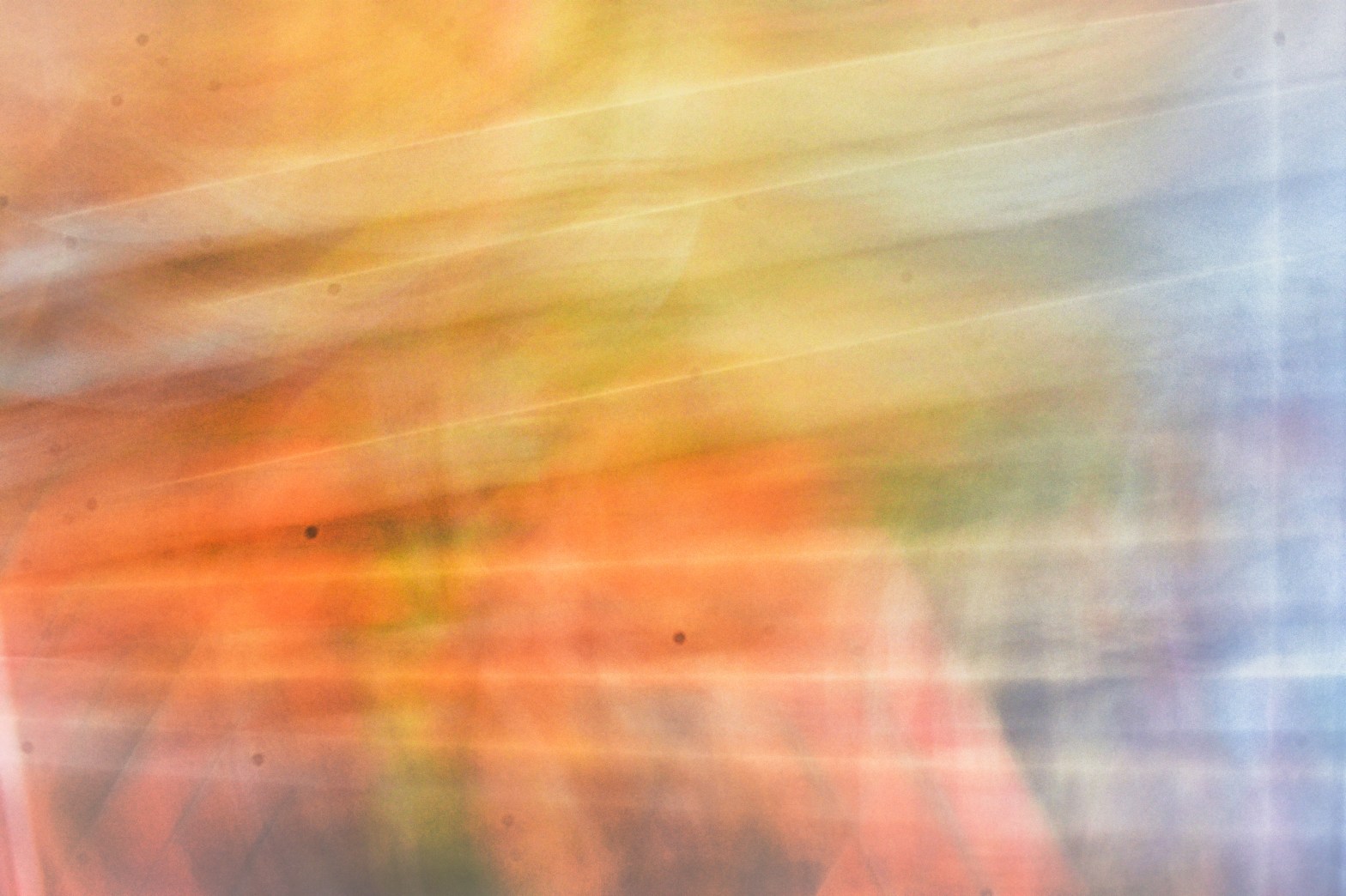
Another use of slow shutter speed and motion blur is an effect called Intentional Camera Movement, or “ICM.” Intentional camera movement is exactly what it sounds like, combining a longer exposure time with intentional movement of the camera. ICM can be used to create a sense of motion in an otherwise still image, or as shown in the image below, to create a more abstract composition.

What kind of images will you create with long-exposure photography this week? Your assignment, should you choose to accept it, is to get out there and find out.
 Eric Culver Photography